18:00
House of Black Heads
Venue info + map
Tickets €28/€20
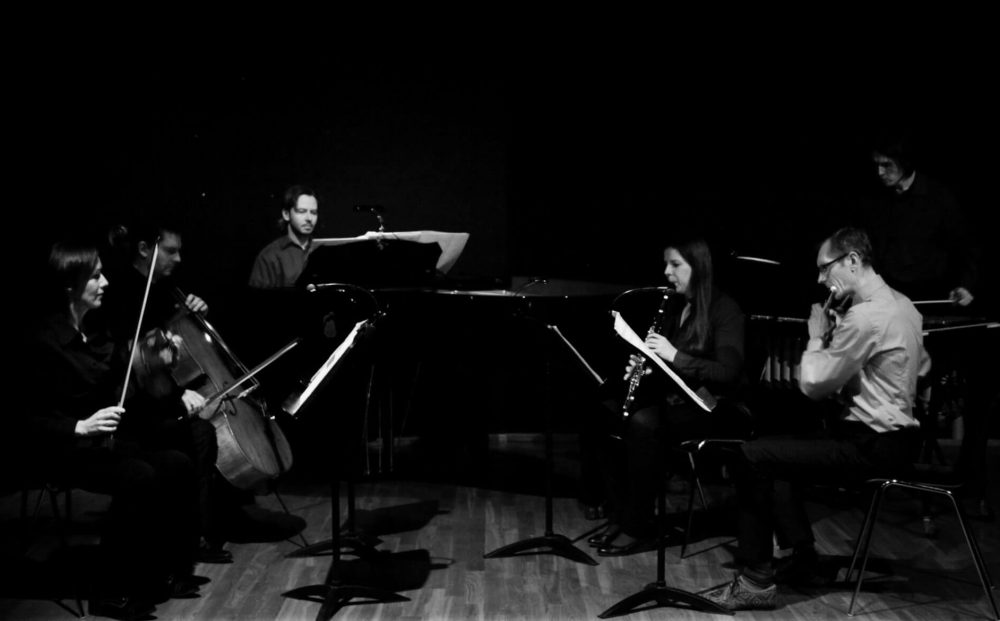
Ensemble of the Estonian Electronic Music Society
Ensemble U:
Kaspar Mänd
Andrus Kallastu
Kris Kuldkepp
Programme:
Udo Kasemets (1919–2014) – Lunharmonics. II. Moon for six sine wave oscillators(1990)
Omar Mark Daniel (b. 1960) – Trio No. 1 for violin, piano, cello: I mvt (1999)
Ilmar Laaban (1921–2000) – Der Rhododendrongeist for three voices (1982)
Jüri Reinvere (b. 1971) – Ricordanza for flute (2012)
Kristi Allik (b. 1952) – Machine Symphony (excerpt, 2000)
Kris Kuldkepp (b. 1993) – Improvisation
Elma Miller (b. 1954) – udok asem ets for choir (1988)
Tarmo Johannes: “Lunharmonics. II Moon (1990) for six sine oscillators is based on the Chinese lunar calendar. Each day and week corresponds to a specific unit of time in the piece, and similar to cosmic changes, the players retune their oscillators from one frequency belonging to the overtone series to another.”
*
Trio No. 1 (1999). Omar Mark Daniel: “I approached writing this trio with a sense of adventure. I knew where I wanted to start, but I was very uncertain about where the process would lead me. I allowed the work to be exploratory, and as time passed, I discovered that I was investigating a world of opposites: light and darkness, silence and activity, transparency and obscurity. This manifests in the first movement, where the listener experiences two seemingly unrelated worlds: on one side, a lament by the violin and cello, juxtaposed against a furious piano part. This principle seems to guide the work as a whole. Sometimes different musical characters are superimposed on one another, and at other times the listener encounters linear shifts in the musical landscape as the narrative develops.”
*
In the late 1950s, Ilmar Laaban became interested in sound poetry, for which Kurt Schwitters served as his primary influence. Laaban himself referred to this type of creative work as “häälutused” (vocalizations). His vocalizations are mostly derived from the French or Swedish languages. In 1998, a CD of Laaban’s vocalizations titled “Ankarkättingens slut är sångens början: poesi & ljudpoesi 1944–1993” (“The End of the Anchor Chain is the Beginning of the Song”, Fylkingen, 1998, CD + booklet) was released in Sweden. Individual vocalizations of his have appeared on numerous other recordings worldwide.
Tarmo Johannes: “Several of the vocalizations written down by Ilmar Laban strongly resemble a musical score. Even though he made these notes primarily for himself, one can see a composer-like polyphonic way of thinking and work with structure. He often pre-recorded some voices and added one voice live during the performance. For example, Der Rhododendrongeist (‘The Rhododendron Spirit’), which will be performed, is written on three score lines, utilizing several markings from musical notation such as dynamics, fermatas, and indications like espressivo and sonoro.”
*
Jüri Reinvere: “Ricordanza (2012) belongs to a planned series of “transcendental études” for solo flute (referencing Liszt’s “Transcendental Études” indirectly) and was written as a mandatory piece for the national competition for wind and percussion instruments. In fact, two such mandatory pieces were created: the simpler “La leggierezza” and the very difficult “Ricordanza,” which, according to my data, only one flutist dared to play. Tarmo Johannes, for whom it presented no difficulty at all, gave the piece its world premiere at his concert. “Ricordanza” also belongs to a cycle of works where I have used my own poetry – in this case very briefly, in the étude’s coda.”
*
Kristi Allik: “Machine Symphony (2000) is a celebration of machines, in all of their aural diversity. All sounds used in this composition are derived from recordings – made in Kingston and its surroundings – of steam engines and other assorted internal combustion machinery; many of the engines recorded and used are from the 19th and early 20th centuries, no longer exist, other than as museum artifacts. The machine sounds were processed and multi-tracked in order to create musical drones and repeated rhythmic patterns. These elements in turn, were arranged similar to an “orchestra” of different instruments, resulting in a “symphony” of sounds that range from “tonal” sonorities to intricate percussive episodes.”
Machine Symphony is taken from Infoweaver, an evening-long multimedia/music theatre work by Robert Mulder and Kristi Allik created in 2000.
*
udok asem ets (1988), Elma Miller: “1988 was an important year: I started doing music notation on the computer and bought the Score software. I also knew that these were more or less the last years I would be writing scores by hand.
When starting to create a new song, it was always difficult to find lyrics. 1989 was the year of Udo Kasemets’ 70th birthday. I planned to take his initials and build a sound structure based on them. I started by looking for Estonian words and selected about 328. Then I filtered the words: long/short, starting with a vowel/consonant, consisting only of vowels (diphthongs), etc. I also wanted the third voice to be the lead—the foundation upon which to build the piece. I imagined a small scene where three friends meet, greet each other, or raise their glasses, etc… For the first performance, which was in Estonian, I thought it would be good if I could get three Estonians together for the concert. The first voice was Prof. Aadu Pilt (a nuclear physicist who could read music), the second was accordionist Tiina Kiik, who was performing at the same concert anyway, and I took the third voice myself.
Over the years, this piece has been performed by three female, three male, or mixed voices, and the staging has always evolved: three men declaiming something, three women at the hairdresser, three young women in leather clothes on stage with motorcycles (on that occasion, the audience went wild because it was a private school for girls, but young men and, of course, parents had been invited to the concert).
When Udo Kasemets’ birthday was celebrated in Montreal, the gems-ensemble performed the piece, and we all laughed as Udo was very surprised that a poem could be created from his name in such a way. In his own work, he often played with words, but not with letters.
Estonian critics have asked what these words mean. In Estonian, it is nonsense—it means nothing! The meaning is whatever the performers themselves wish it to mean.”
Over time, many people have left Estonia, including composers and musicians. During the years of the Iron Curtain, connections with the outside world were fragile; music created by authors of Estonian descent living abroad did not reach Estonia and remains largely unknown here to this day. Today’s concert helps to fill these gaps, as ensembles from the Estonian Centre of Contemporary Music perform music by the Estonian diaspora spanning several decades.
The Estonian Centre for Contemporary Music (MTÜ Eesti Nüüdismuusikakeskus) was founded in 2021 with the goal of developing and promoting contemporary music. The centre brings together Estonia’s key contemporary music organisations and units and is a partner of the UNESCO City of Music Tallinn programme. The centre has become an important platform and support system for the renewal and growth of the contemporary music field.
The concert will be followed by a panel discussion at the Estonian Centre of Contemporary Music titled “Freedom, Boundaries, and Sounds: The Paths of Estonian Contemporary Music in the World.”