13:00
St. John's Chruch, Tallinn
Venue info + map
Tickets €28/€20
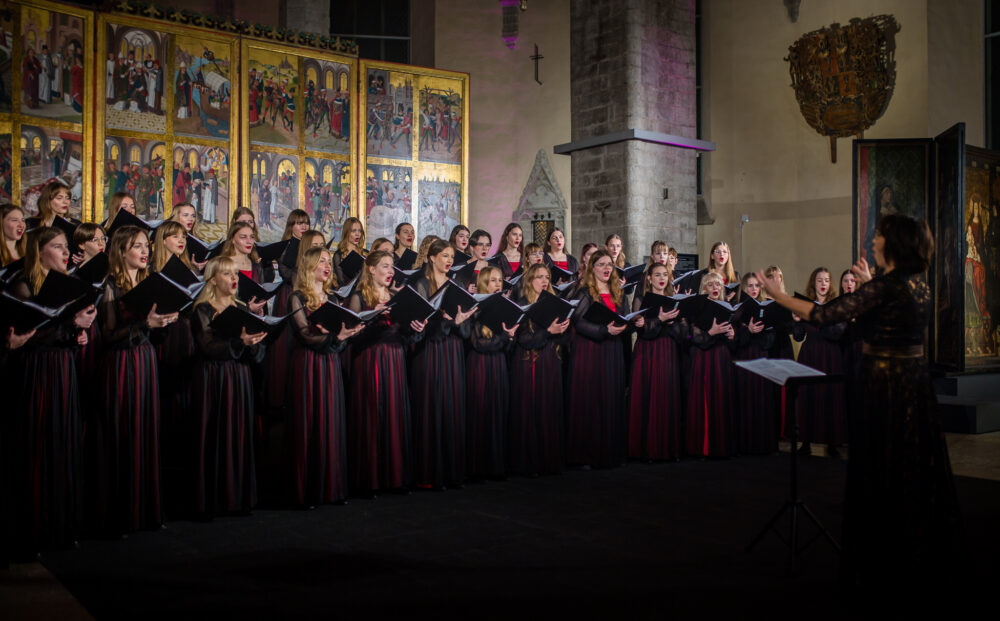
Ellerhein Girl’s Choir
Conductor: Ingrid Kõrvits
Kadri Traksmann (organ)
Jan Marius Laur (trumpet)
Triin Ustav (trumpet)
Teele Lehtpuu (percussion)
Programme:
Mart Saar (1882–1963) – Nature’s Greetings to the Sun (1924, from fairy tale play Lost Princess, text Julius Oro)
Mart Saar – The Song Leader (1910, text folklore)
Veljo Tormis (1930–2017) – Summer Motifs (1969, from Nature Pictures, text Aleksander Suuman)
I Dry Weather
II Thunderstorm
III Summer Night
Conductor: Paula Kõrvits
Veljo Tormis – Sad Singer (1971, from Songs About Song and the Singer, text folklore)
Soloists: Monika Alu, Klaara Süld, Alice-Ly Talve and Viktoria Pärn
Mariliis Valkonen (b. 1981) – A Leaf of Memory Bloomed on the Tree of Life (2026, premiere, text Mats Traat)
Kristo Matson (b. 1980) – “Mis oli enne mind” (2026, premiere, text Viiu Härm)
I Olles vihmana teel
II Viies põlv
III Ma tahan uskuda
Arvo Pärt (b. 1935) – Peace upon you, Jerusalem (2002, text psalm 122)
Urmas Sisask (1960–2022) – It Rings Out Over the Fields (from cycle 12 Songs in Honor of the Holy Virgin Maria, text from Catholic Prayer book)
Soloist: Lisanna Toomik
Urmas Sisask – Benedicamus Patrem (2003, text from the Benedicite, Book of Daniel)
Soloist: Karoliine Alamaa
Mart Saar (1882–1962) was among the first professional Estonian composers. Like many of his contemporaries, he received his musical education at the Saint Petersburg Conservatory, where he studied in Louis Homilius’s organ class from 1901 to 1908, graduating with a silver medal. Afterward, he settled in Tartu but continued to travel to the capital of the Tsarist Empire until 1911 to further his studies in composition. The young composer was particularly influenced by the composer and pedagogue Nikolai Rimsky-Korsakov, who, as an enthusiast of folklore himself, taught his students not only to appreciate folk melodies but also to recognize their unique character, encouraging the use of techniques that differed from classical harmony. And although Saar had initially shown himself to be a modernist composer at the beginning of his creative path—in his first solo songs and piano pieces, as well as some choral works—a change soon followed. Born and raised in the heart of nature at the Hüpassaare forester’s farm, the author eventually set aside his explorations of modern style and became one of the founders of the Estonian national musical idiom. It is precisely this turning point that is reflected in the 1910 song “Laulu eestvõtja” (The Song Leader).
The opening song of the concert, “Looduse tervitus päikesele” (Nature’s Greeting to the Sun), is taken from Mart Saar’s music for the fairy-tale play “Kadunud printsess” (The Lost Princess, 1924) with text by Julius Oro. Julius Oro (Oengo, 1901–1941) was a well-known children’s author and the lyricist of popular songs, such as the toddler book “Muna” (The Egg) or the song “Tiliseb, tiliseb, aisakell” (Jingle, Jingle, Sleigh Bell). “Kadunud printsess” premiered as a concert performance in 1925 at the Estonia Concert Hall. This incidental music is also the source of, for example, the famous “Lindude laul” (Song of the Birds). Following a successful performance, Hanno Kompus, the opera director of the Estonia Theatre at the time, proposed that Saar orchestrate the material. For some reason, however, the project never came to fruition, and thus the material in question faded into obscurity. The Ellerhein Girls’ Choir is known to have performed it only once during the intervening years, in 1977, until at the initiative of Ingrid Kõrvits and in connection with Mart Saar’s 140th anniversary, “Kadunud printsess” was performed by all Ellerhein choirs in 2024 at the same Estonia Concert Hall; simultaneously, the sheet music and a recording were completed.
*
Veljo Tormis (1930–2017) was Estonia’s most powerful choral composer in the second half of the 20th century, and an author highly esteemed throughout the wider world. “Suvemotiivid” (Summer Motifs, 1969, lyrics by Aleksander Suuman) belongs to the cycle “Looduspildid” (Nature Pictures), along with “Kevadkillud” (Spring Fragments, 1966), “Sügismaastikud” (Autumn Landscapes, 1964), and “Talvemustrid” (Winter Patterns, 1968). For a sound artist who was born (Kuusalu) and raised (Vigala) in the lap of beautiful nature, and who was inspired by folk songs and folklore, his close connection to the living natural world is clearly palpable. In all these cycles, the author has sensitively followed the text, striving to find expressive sonic counterparts to the words. As a successor to the ideas of Mart Saar, Tormis primarily became a user of the ancient regivärss (runic) folk melody as a creative source.
“Kurb laulik” (The Sorrowful Singer, Kuusalu melody, traditional lyrics) belongs to the cycle “Laulud laulust ja laulikust” (Songs about Song and the Singer, 1971) and is dedicated to Jaan Kaplinski (1941–2021). Veljo Tormis: “The songs [of this cycle] are dedicated to people who had influenced me in the fields of folkloristics and folk song at that time or were somehow kindred spirits.” Tormis had encounters with Jaan Kaplinski on several occasions. For instance, Tormis wrote the solo song cycle “Kümme haikut” (Ten Haikus, 1966), “Kevadkillud” (Spring Fragments, 1966) for female choir, or the powerful “Maarjamaa ballaad” (Ballad of Mary’s Land) based on his texts; the latter was completed for the 25th anniversary of the Estonian National Male Choir (RAM) and won first prize in the male choral song competition held for the occasion. Furthermore, Kaplinski compiled the texts for works such as “Naistelaulud” (Women’s Songs, 1977), which were based on folklore. Tormis noted: “[Hando] Runnel used folk song in his poetry much more than Kaplinski, but theoretically, it was Kaplinski who discussed the subject more. For example […] in 1997, Kaplinski published the book ‘Võimaluste võimalikkus’ (The Possibility of Possibilities), which contains several articles on folk song and mainly on the themes of regilaul. There is an article here called ‘Rahvalaulu juurde jõudmine’ (Arriving at the Folk Song) […], written in 1970–72. That was the time when we did some folk song arrangements with him. But the process of reaching that point must have happened before that; here he has only provided a summary.” (From the book “Veljo Tormis. Jonni pärast heliloojaks”).
*
“Kus elupuul puhkes mäluleht” (A Leaf of Memory Bloomed on the Tree of Life) for girls’ or female choir (2026, world premiere). Text: excerpts from Mats Traat’s poems “Mälu” (Memory), “Kaskede all kõneleb hea” (The Good Speaks Beneath the Birches), “Mõte” (Thought), “Usk” (Faith), “Taastajad” (The Restorers), “Oli aeg” (There Was a Time), and “Ei tihene tõeks” (Does Not Thicken Into Truth). Mariliis Valkonen: “‘Kus elupuul puhkes mäluleht’ is a choral work about remembering one’s roots and recognizing one’s beginnings. The piece moves between alternating musical states: fast and suggestive passages with incantatory text, driven by repetition and rhythmic impulse, alternate with more melodic, expansive moments—or ‘bloomings.’ These contrasts reflect the layered nature of memory—its recurring voice and its moments of illumination.”
*
Kristo Matson: ““Mis oli enne mind” (What Was Before Me, 2026, world premiere, text by Viiu Härm) is an a cappella cycle in three parts for girls’ choir. While considering this year’s festival theme, “Stories,” I began to wonder which stories or texts might resonate with young people and which narratives they could truly relate to. With these questions in mind, I read through a vast amount of poetry by Estonian authors until I came across three texts by Viiu Härm that stayed with me.
The first part is titled “Olles vihmana teel” (Being on the Way as Rain) and is like a journey into oneself, one’s development, and one’s personal search.
The second part, titled “Viies põlv” (The Fifth Generation), is a look back at five different generations who pass down something that makes us human and significantly shapes our mental landscape as we grow. While creating the music for this second part, I thought of the composer Veljo Tormis and his powerful musical legacy.
The third part, “Ma tahan uskuda” (I Want to Believe), summarizes the process of growing into a person briefly and unequivocally: by believing in ourselves, we can be exactly who we wish to be, and in that way, we live on.”
*
In his choral works, Urmas Sisask easily and inventively combines elements from all sorts of sources. This is often held together by an intense, almost magical rhythmic flow. His choral pieces are frequently characterized by a simple musical language, being very singer-friendly and melodic, with a highly infectious rhythm and an imaginative, vivid musical imagery. Consequently, his work is highly regarded among performers—he was the most frequently performed choral composer in Estonia at the end of the 20th century.
In his choral music, Sisask utilized both Latin and Estonian texts. The collection 12 laulu püha Neitsi Maria auks (12 Songs in Honor of the Blessed Virgin Mary), Op. 41, was completed in 1992, and “Heliseb väljadel” (Ringing in the Fields) is one of the most marvelous movements from this beautiful cycle.
Benedicamus Patrem, Op. 90, was completed in 2003. It was premiered that same year by the Ellerhein Girls’ Choir, conductor Tiia-Ester Loitme, and the author on the shaman drum at the Europa Cantat festival in Barcelona, Spain.
Let us bless the Father and the Son with the Holy Spirit.
Let us praise and exalt him above all forever.
Blessed art thou, O Lord, in the firmament of heaven.
And worthy to be praised, and glorious, and exalted above all forever.
O Lord, hear my prayer.
And let my cry come unto thee.
(And) The Lord be with you.
And with thy spirit.
Grant us peace.
Amen.
Ellerhein Girls’ Choir, founded in 1951 by the legendary music educator and conductor Heino Kaljuste, is one of Estonia’s most acclaimed youth ensembles. The choir has won numerous international awards, received a Grammy (2004), and performed in prestigious concert halls worldwide. Since 2012, the choir has been led by Chief Conductor Ingrid Kõrvits. The concert program features new works (Mariliis Valkonen, Kristo Matson) alongside beloved Estonian choral classics (Mart Saar, Veljo Tormis, Arvo Pärt, Urmas Sisask).
The choir’s vocal coach is Egle Veltmann, choir master Ülle Sander.
The concert is held in collaboration with Tallinn Music Week.