21:00
Estonian National Opera Chamber Hall
Venue info + map
Tickets €28/€20
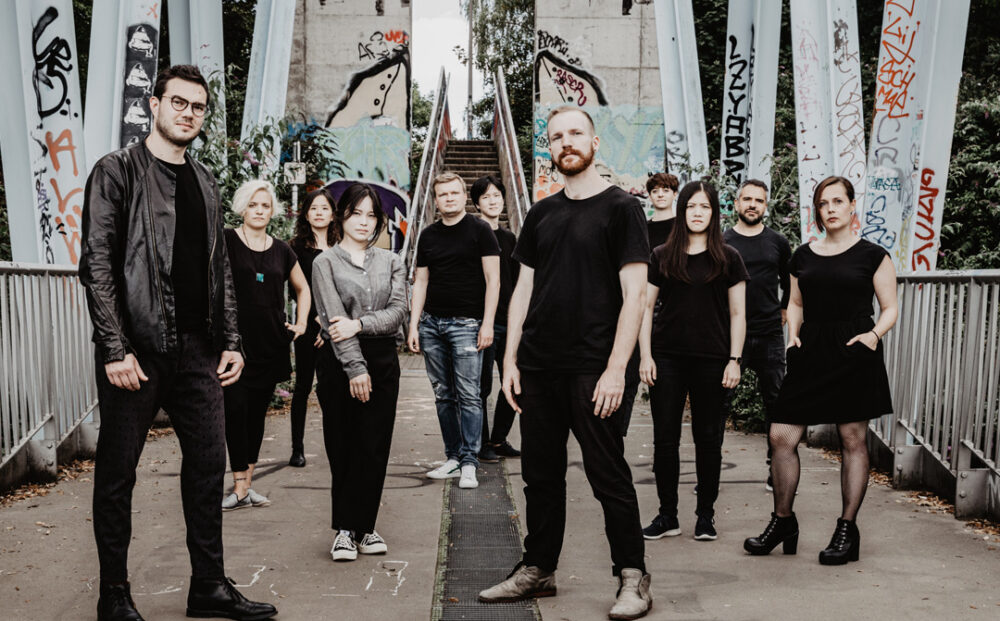
Broken Frames Syndicate (Germany)
Lola Rubio (violin)
William Overcash (violin)
Laura Hovestadt (viola)
Nathan Watts (cello)
Katrin Szamatulski (flute)
Moritz Schneidewendt (clarinet)
Peng-Hui Wang (bassoon)
Talvi Hunt (piano)
Yu-Ling Chiu (percussion)
Lautaro Mura Fuentealba (conductor)
HELLO DARKNESS – A Night Journey Through Contemporary Dreamworlds
Hello Darkness (2025) – for tape (prod. Hovestadt/Watts/Schneidewendt, inspired by Simon & Garfunkel)
Anna Thorvaldsdottir – Ró (2013, Estonian premiere) for ensemble
Patrick Schäfer – Dunkle Mitte (2025, Estonian premiere) with poems by Nadja Küchenmeister, for ensemble and electronics
I. Choral
II. Recitativo
III. Aria
IV. Recitativo
V. Choral
Sarah Hennies – Memory Box (2021, Estonian premiere) for performers
Malle Maltis – Night Music (2013)
Tatjana Kozlova-Johannes – The Story of Eros (2026) for ensemble
I The Speed
II Supreme Lyricism
III The Darkness
IV The Drama
V Simplicity
Michael Gordon – The Light of the Dark (2008, Estonian premiere) for flute, clarinet, percussion, piano, violin, and cello
Patrick T. Schäfer: “In Dunkle Mitte (Dark Center, lyrics by Nadja Küchenmeister, 2025), the lyrical ‘you’ is in a hospital in a state between life and death—perhaps in a coma. In the five poems, the lyrical ‘I’ addresses their own inability to change the situation, the wait for awakening, and the meaning of their own life in the face of the death of a loved one. Countless poetically sensual images and thoughts come to light: when machines negotiate a person’s life, when one reads from napkins how everything ends, when blood turns to broth and brown lake landscapes push through the pavement.
The piece is inspired by a state of ‘being in between’, oscillating between life and death, being human or machine, being here or not being here. Accordingly, the composition moves between two poles: musical piece and reading.
The materials used—language itself, pitches, and noises—aim to convey both content and emotion in equal measure. Thus, language is sometimes musicalized, and sometimes music becomes the carrier of content. Language, pitches, and noises are spoken/sung/produced by the entire ensemble as well as played back from a sampler/tape. The aim is to create a dense network of relationships between language, sounds, the ensemble, and electronics. The audience is led into an acoustic reality in which boundaries become blurred: between genres, materials, live-generated and electronic sound.”
*
In Memory Box (2021) the composer Sarah Hennies invites performers to pull from their own personal experiences. “The performers are asked to choose five memories related to sound and write short texts about them,” Hennies explains. “These memories are spoken throughout the piece, creating a sound collage that blends noise, musical tones, and personal narratives. It’s like a forest of identities happening all at once.” Broken Frames Syndicate uses the instructions of the score as an inspiration to think about and remember our own childhood memories, dreams and nightmares.
*
Malle Maltis: “Night Music (2013) is based on Karlheinz Stockhausen’s text composition of the same name from the collection Aus den sieben Tagen (From the Seven Days). The audio material in his composition is nature recordings and electronics sounds. I have combined the chirping of crickets recorded on Muhu island on an August evening with electronic “wind” and electronic “crickets” and other sounds created with SuperCollider.”
play a vibration in rhythm of the universe
play a vibration in rhythm of dreaming
play a vibration in rhythm of dreaming
and slowly transform it
into the rhythm of the universe
repeat this as often as you can
*
The Story of Eros for ensemble (2026, premiere). Tatjana Kozlova-Johannes: “The idea to write a work on the theme of Eros came from the ensemble Broken Frames Syndicate—the piece will be performed in Germany at a concert dedicated to Eros. While writing the piece, I drew from the Jungian psychoanalytic approach, according to which Eros is associated not only with sexuality and the thirst for love, but more broadly with psychic energy that acts as a unifying principle, promoting connectedness and the integration of opposites. During the writing period, my own energy level was quite low, and I searched the music for an impulse that could revitalize even me. Thus, the central question became: what kind of music would generate energy and vitality in me right now? Moving away from my usual methods of developing material, I allowed the music to be more immediate and intense. Gradually, a certain symbolic narrative began to take shape in the work—five conditional sections emerged, which I titled Speed, Supreme Lyricism, Darkness, Drama, and Simplicity.”
*
Michael Gordon: “The light of the dark (2008) was written for the ensemble Eighth Blackbird. In my initial conversations with the musicians, they mentioned the “other” instruments that they play (accordion, guitar, percussion…), and I imagined a chaos onstage, with the musicians grabbing the nearest available instrument and playing music on it. The piece starts with a heavy-metal-esque cello line and builds from there into a kind of out-of-control late-night jam session, complete with unpredictable metallic crashes, swirling virtuosic fiddling and colliding glissandos.”
The program takes the audience on a journey exploring the different faces of darkness—is it a comforting, protective force or a threatening gloom? Six composers express their personal relationship with darkness from various perspectives.
Broken Frames Syndicate is an ensemble of eleven musicians based primarily in Frankfurt, dedicated to contemporary music and the renewal of concert culture. Founded in 2018 by graduates of the International Ensemble Modern Academy, the collective is known for its bold programming, interdisciplinary collaborations, and work with young composers.
The concert is supported by Goethe Institute.