19:00
Estonian Music and Theater Academy Concert Hall
Venue info + map
Free admission!
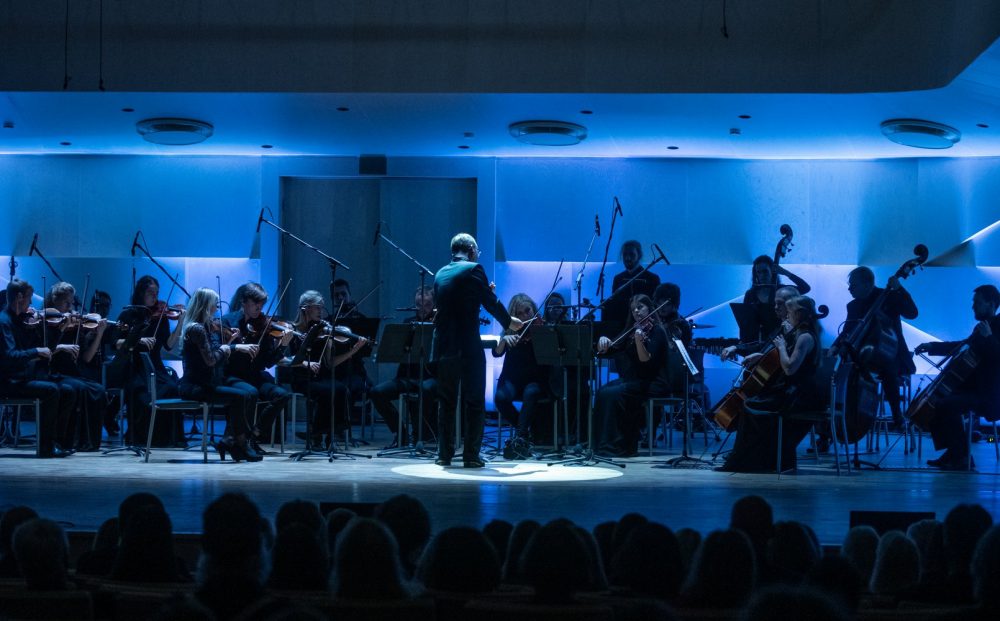
EAMT Sinfonietta
Conductor: Toomas Vavilov
The latest compositions from the students of the Estonian Academy of Music and Theatre Composition Department.
Klaus Brandstetter – Ostinato in Bloom (2026, premiere)
Elvis Delinš – Tremble (2026, premiere)
Sofiia Shcherbakova – In a Heartbeat (2026, premiere)
Dimitrios Konstantinos Rizos – Anamnesis (2026, premiere)
Inessa Green – Sinfonietta (2026, premiere)
Säde Semper – 00–01 (2026, premiere)
Erik Rauk – Procession (2026, premiere)
Klaus Brandstetter: “Ostinato in Bloom is built on a chaconne-like ostinato that serves as the structural core of the piece. From this recurring motive, unfolds a continuous chain of variations, gradually transforming its character, texture, and harmonic environment. Rather than presenting clearly separated variations, the music evolves organically: the motive is expanded, fragmented, and recontextualized, revealing different facets of the same underlying idea. At times rhythmic and dance-like, at others more suspended and reflective, the material constantly reshapes itself while remaining rooted in the original pattern. The title refers to this process of gradual unfolding, as the initial figure acts as a seed from which increasingly complex musical gestures emerge.”
*
Elvis Dēliņš: “Tremble (2026, premiere) – the themes of the piece revolve around inner strength and the depths where humane and divine are indiscernible. In my few previous pieces, such as the Flashes Forward for mandolin and ensemble and Entering for solo flute, I began to utilize tools of the spectral music. There, one of the main ways of producing harmonies was through distortion of the natural spectrum. For the piece presented today I tried a new technique. The “chords” or harmonic fields were indirectly obtained through frequency modulation: I chose two frequencies which then were multiplied many times to produce a pool of many related pitches, from which I could choose a selection (a “chord”) that would best serve my intended musical purposes. Additionally, the section and subsection lengths were derived from the numerical values of the letters of the section names. The main reason (and the most effective result) for using frequency modulation was to create bright, shimmering and captivating harmony, in which even the seemingly unrelated pitches would all resonate as if coming from a single source.”
*
Anamnesis (2026, premiere). Dimitrios Konstantinos Rizos: “In Plato’s philosophy, the concept of anamnesis describes knowledge as recollection. According to this idea, the human soul has encountered truth before its earthly life and retains traces of that knowledge within it. What we call learning is therefore not the acquisition of something entirely new, but the gradual recollection of what the soul has already known. This work draws on this philosophical concept primarily as a poetic framework. The music unfolds as a space of remembering, where fragments surface like distant memories—appearing, fading, and transforming.”
*
Inessa Green: “Sinfonietta (2026, premiere) takes place during wartime and is also a documentary story about two refugees whose love saves them and leads them to Estonia. The chaos that began during the war leads to a climax, where the unison theme of love gives hope for the end of the war, but the irregular meter and multiphonic scale atonal harmonies end the work in silence without reconciliation.
*
00–01 (2026, premiere). Säde Semper: “The piece is a movement between two planes, evolving slowly from one phase of being to another and later back again. Although the purpose of the piece is to conclude harmonically, reaching there seems to be hard.”
*
Erik Rauk: “Procession (2026, premiere) is inspired by the life story of Eduard Profittlich, who was beatified on September 6, 2025.”
Wikipedia: “Eduard Gottlieb Profittlich (1890 Birresdorf, Rhineland – 1942 Kirov prison, Russia) was a Catholic clergyman of German descent and a Jesuit. In 1912, he began his theological studies; in 1913, he joined the Society of Jesus, and on August 27, 1922, he was ordained a priest. In 1924, he received a doctorate in philosophy and theology from the University of Kraków. Profittlich began his spiritual service in Poland in 1924, worked in Germany starting in 1925, and in Estonia from 1930 onwards. In 1931, he was appointed the Apostolic Administrator of Estonia, and on December 27, 1936, he was consecrated as a bishop. Eduard Profittlich became the first Catholic bishop in Estonia since the Estonian territories came under Lutheran Swedish rule in the 17th century. He was a recognized preacher and pastor who initiated the publication of Estonian-language religious literature and founded the Estonian Catholic magazine Kiriku Elu (Church Life). He sought to change the perception of the Catholic Church as a ‘Polish church’ to one that was more open and closer to Estonians. When Estonia was occupied by the Soviet Union in 1940, Profittlich requested permission from the German embassy for Catholic priests and nuns to travel to Germany while he himself remained in Tallinn. He was arrested on June 27, 1941, and deported to Russia, where he was sentenced to death by shooting on November 21. Eduard Profittlich died on February 22, 1942, in Kirov prison before the execution of the sentence. Bishop Philippe Jourdan initiated the official beatification process for Profittlich in 2017; permission was granted by Pope Francis on December 18, 2024, and the solemn beatification mass took place on September 6, 2025, at Freedom Square in Tallinn. A room in the Tartu Catholic Education Center is named in honor of Eduard Profittlich, and a memorial plaque has been placed in the Peter and Paul Roman Catholic Cathedral in Tallinn in his memory.”
The EAMT Sinfonietta is the training orchestra of the Estonian Academy of Music and Theatre, consisting of students and, where necessary, professional guest musicians. Alongside classical repertoire, the orchestra performs compositions by young composers and serves as a practice platform for student conductors. This concert features premieres of works completed during the current academic year, supervised by Helena Tulve, Tõnu Kõrvits, Toivo Tulev, and René Eespere. The concert is conducted by Toomas Vavilov.
The concert is held in collaboration with the Estonian Academy of Music and Theatre.