19:00
Estonia Concert Hall
Venue info + map
Tickets 35/25€
Buy tickets
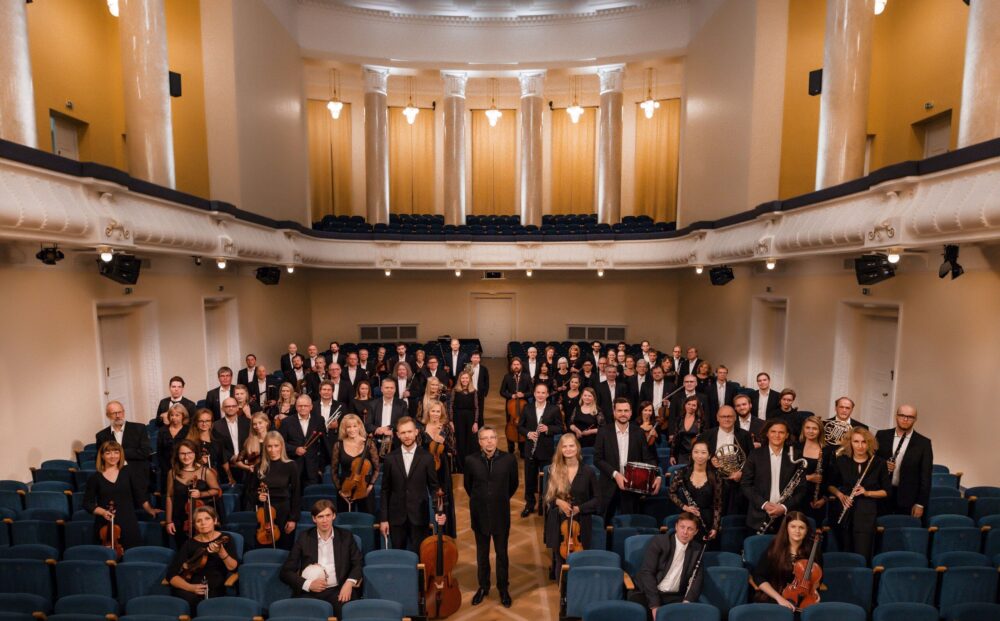
Estonian National Symphony Orchestra
Conductor: Olari Elts
Soloists: Hans Christian Aavik (violin)
Heili Rosin-Leivategija (piccolo)
Sara D’Amico (harp)
Liisa Hirsch (b. 1984) – Rising Realms (2026, premiere)
Riho Esko Maimets (b. 1988) – Ecdysis, double concerto for piccolo and harp (2023, Estonian premiere)
Erkki-Sven Tüür (b. 1959) – Violin concerto No. 2 “Angel’s Share” (2018)
Lepo Sumera – Symphony No. 2
I Moderato tranquillo
II Interludium
III Spirituoso
Liisa Hirsch: Rising Realms (2026, premiere) draws its initial impulse from the large-scale abstract paintings of Gerhard Richter — works whose pulsating, layered colour fields resist fixed interpretation. An abstract image does not tell a finished story; rather, it creates a field in which meaning arises through encounter. The artwork does not speak alone: it is completed by the viewer’s memory, perception, and history of attention.
A similar principle shapes Rising Realms. The work is built around five symmetrical, fourteen-part chords spanning the full range of the orchestra. Each chord contains a quarter-tone interval embedded within its structure, creating harmonic constellations that feel at once familiar and subtly displaced — like circles of fifths shifted a quarter tone out of alignment. They can function as self-contained harmonic realms, with their own internal tensions, colour, and position along the consonance–dissonance spectrum. Working within these harmonic fields, new relationships and associations gradually revealed themselves. The overall form arose intuitively, shaped less by predetermined narrative than by attentive listening to the material itself.
At the same time, the piece is inseparable from the moment of its creation. Thinking of Lepo Sumera, the centenary of Morton Feldman, and the ongoing images of people gathering in streets across the world to stand for their freedom, formed an unspoken background layer. These influences are not quotations or explicit references, but rather a shared atmosphere — the air of an era filtering into sound.
*
Riho Esko Maimets: “Ecdysis (2023) marks a watershed in my compositional journey. Before writing this piece, I approached composition with profound anxiety and a persistent sense of obligation to be “good”, to produce something of demonstrable quality, and, to my own chagrin, to be “listener-friendly”. These external value judgments steadily eroded my creativity. I recall feeling tortured and suffocated whenever I sat down to compose. I remember being risk-averse, emotionally cold and calculating, insincere, confused, and depressed.
The task of writing a double concerto for piccolo and harp initially proved so overwhelmingly difficult that it forced me, quite literally, to relearn how to compose. This feeling was intensified immeasurably by a life-changing event: I became a father. Ecdysis was finished two months after the birth of my daughter, under conditions of extreme fatigue and emotional intensity. In stark contrast to my earlier, largely unproductive working methods, I made a conscious decision to embrace curiosity and playfulness, in order to allow artistic choices to emerge from visceral impulse and whim rather than calculation. In doing so, I relearned not only how to compose, but how to take risks and how to trust my instincts. The title Ecdysis refers to the biological process by which reptiles and insects shed their old skin, allowing for growth, regeneration, and rebirth.
Ecdysis was commissioned by my sister Kaili Maimets for the Kitchener-Waterloo Symphony (Canada) in commemoration of her godfather Tiit. It was premiered on 22 April 2023 by Kaili Maimets (piccolo), Lori Gemmell (harp) and the Kitchener-Waterloo Symphony Orchestra, conducted by Alexander Shelley.”
*
Violin Concerto No. 2 Angel’s Share (2018). Erkki-Sven Tüür: “This composition is dedicated to the UBC (Uisge Beatha Club), which has been active in Estonia and elsewhere since 1989, and was commissioned entirely outside of official institutions by a generous anonymous sponsor. ‘Angel’s Share’ is undoubtedly an apt title in this context as well. It is a known fact that over the years, as whisky matures in oak barrels, about 2% of the liquid is lost annually. During this process, the spirit loses its raw flavor and aroma characteristics, while simultaneously becoming ennobled by the wood of the barrel with dignified and pleasurable nuances. The amount of liquid lost is called the ‘angel’s share.’ I like to think that as we mature as individuals, we should also gradually rid ourselves of certain unnecessary qualities—hopefully, our guardian angels help us in this as well…”.
World premiere: Hugo Ticciati (violin), Tallinn Chamber Orchestra, conductor Risto Joost, May 3, 2018.
*
Both for Lepo Sumera himself and for the history of Estonian music in general, his “Pala aastast 1981” (“Piece from the Year 1981”) and the 1st Symphony (based on the themes of that piece) were groundbreaking works. The keywords for these works are euphony, diatonics, triads, scales… After decades in which sharper harmonies had dominated Estonian music, these works felt like a revelation. The Symphony No. 2, completed in 1984, was created in this same vein. The author wrote about it as follows: “The three movements of the work are based on a few core motifs, the most important of which is heard right at the beginning from two harps. In fact, the musical plan of the entire symphony can be articulated through this theme: the story of the development of a melody consisting of short two-, three-, or four-note motifs (in the first movement) into long, ‘endless’ melodies passing through all minor keys (in the third movement). Thus, the third movement is the goal of this symphony. It is also the reason it was written, because it was not so much the musical development that fascinated me, but the opportunity to reach liberated string melodies that strive toward infinity.” In this context, it is interesting to note that just as the 1st Symphony grew out of a piano piece, the 2nd Symphony was partially developed or written out in the violin and piano piece “Quasi improvisata”.
Symphony No. 2 is dedicated to conductor Peeter Lilje, who premiered it with the ERSO on April 2, 1984, at the Soviet Estonian Music Festival, which was the name of the EMP (Estonian Music Days) at the time. For this composition, the author received the Estonian SSR Annual Music Prize in 1985.
The Estonian National Symphony Orchestra (ERSO) is one of Estonia’s flagship ensembles and its oldest symphonic unit. In December 2026, ERSO will celebrate its 100th anniversary. This evening’s program features a new work by Liisa Hirsch, alongside the Estonian premiere of Riho Esko Maimets’ double concerto for piccolo and harp, featuring soloists Heili Rosin-Leivategija and Sara D’Amico. The brilliant violinist Hans Christian Aavik will perform Violin Concerto No. 2, subtitled Angel’s Share, by Erkki-Sven Tüür, one of Estonia’s most internationally renowned composers. According to the composer, the title refers to the natural evaporation that occurs during the whiskey-making process, metaphorically representing everything unnecessary that a person sheds during the process of maturing. The concert concludes with the powerful Symphony No. 2 (1984) by Lepo Sumera, one of Estonia’s most significant symphonists.
The winner of the „LHV New Composition Award Autasu“ 2026 will be announced at the concert.
The concert is held in collaboration with the Estonian National Symphony Orchestra.