15:00
Club Hall
Tickets €28/€20
Buy tickets
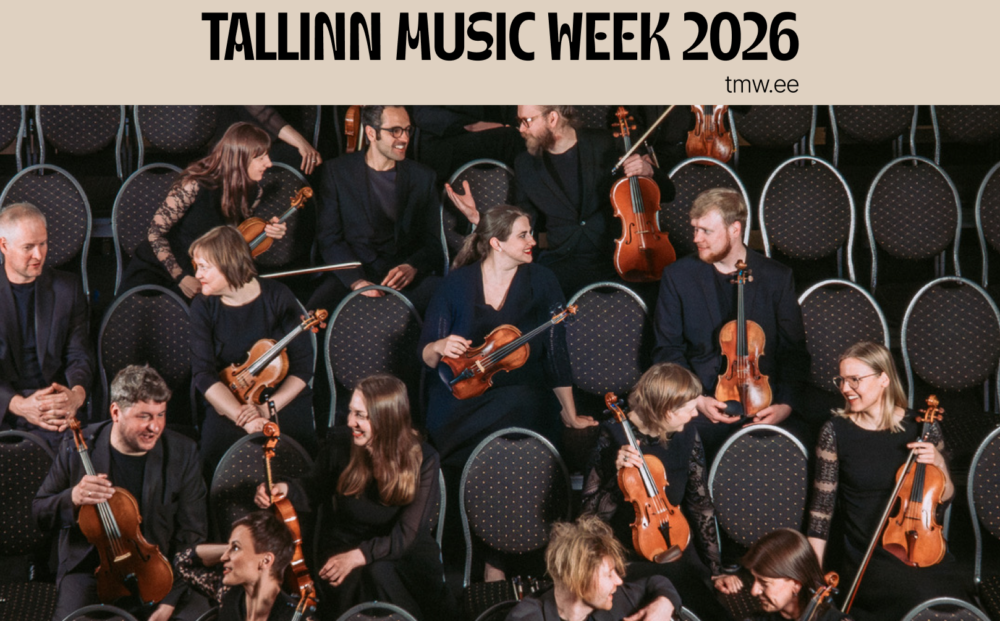
Tallinn Chamber Orchestra
Conductor: Erle Kont-Vilson
Soloists: Vambola Krigul (percussion)
Joonas Mikk (vocals, Estonian National Boys’ Choir)
Actor: Richard Ester (Estonian Drama Theatre)
Lighting Artist: Sebastian Talmar
Costume Artist: Lisette Sivard
Director: Astra Irene Susi
Programme:
Liis Jürgens (b. 1983) – Whisperer. Sun Temple (2026, premiere) for timpani and string orchestra
Maria Rostovtseva (b. 1988) – Golden egg (2026, premiere)
Astra Irene Susi (b. 1998) – Emergence of Light (2026, premiere, text Ene Mihkelson, Hermann Hesse, Hando Runnel, Rein Raud, Jaan Malin)
The concert performance Birth of Light features world premieres by composers Maria Rostovtseva, Astra Irene Susi, and Liis Jürgens. Birth of Light is not born from a desire for quick harmony, but from the belief that true artistic truth lies in the friction between elements.
The programme is brought to the audience by the Tallinn Chamber Orchestra and conductor Erle Kont-Vilson. Soloists are Vambola Krigul (percussion), Joonas Mikk (vocals, Estonian National Boys’ Choir), and actor Richard Ester (Estonian Drama Theatre). The artistic vision is brought to life by director Astra Irene Susi.
Liis Jürgens Whisperer. Sun Temple for timpani and string orchestra (2026, premiere): “For a long time, the working title of the piece was simply and abstractly ‘TIMP’. This story carried several other titles along the way, such as ‘Palimpsest’, ‘Space of Possibilities’, and ‘Doubles’. Ultimately, ‘Whisperer’ (Lausuja) and ‘Sun Temple’ remained.
In the first movement, the timpani soloist is the whisperer—a creator of their own reality. In the second movement, we hear a rhythm borrowed from the Sun Temple in Jaipur, played on the nagara (an Indian kettle drum and predecessor to the timpani) during morning sunrise rituals.
Even before traveling to India, I knew I was preparing to write for the timpani and had already met with the future soloist, Vambola Krigul. Encountering timpani-like instruments in India was thrilling; it felt like a sign or confirmation that I was on the right path. I decided to record a small audio memory on my phone to bring that impression to the audience, transposed for Western instruments. In that small, domed temple, the low sound of the large nagara resonated through the entire body, much like bass from a club speaker today.
Lately, I’ve had the impression of an unwritten rule in contemporary music: that regular rhythm and pure triads—unless they are very subtly hidden within the work—are taboo. Therefore, the music here flirts with that observation. From a compositional standpoint, the work relates the physical-improvisational world to the abstract-neutral-aleatoric one. As an aid for the aleatoric elements, the randomness service random.org was utilized.
The work was commissioned by Estonian Music Days and is dedicated to Vambola Krigul.”
*
Maria Rostovtseva: “The Golden Egg (2026, premiere) draws its inspiration from the Dutch writer Tim Krabbé’s novella Het gouden ei (The Vanishing) and the film Spoorloos (The Vanishing), which was adapted from the book. At the center of my composition is the female protagonist’s dream of a golden egg and the meaning this image acquires in the context of the story’s ending.”
Once, as a little girl, she dreamed that she was locked inside a golden egg that flew through the universe. Everything was pitch-black; there were no stars at all. She would have to stay there forever, and she could not even die. There was only one hope: another golden egg was flying through space. If it collided with hers, both would be destroyed, and everything would be over. But the universe was so vast!
(Tim Krabbé, The Vanishing, translation Claire Nicolas White, Random House, 1993, pp. 13–14.)
*
Astra Irene Susi: “Emergence of Light (2026, premiere) is a musical composition in eight scenes, taking its starting point from the internal struggle of man and the paradoxical presence of eternity within the grayness of everyday life. It is a journey toward unity across time and space that, at first glance, appear fragmented and contradictory. It is the belief that light is coming and, at the same time, has always been within us. The work features texts by Ene Mihkelson, Hermann Hesse, Hando Runnel, Rein Raud, and Jaan Malin.”
*
The concert is held in collaboration with Tallinn Music Week.