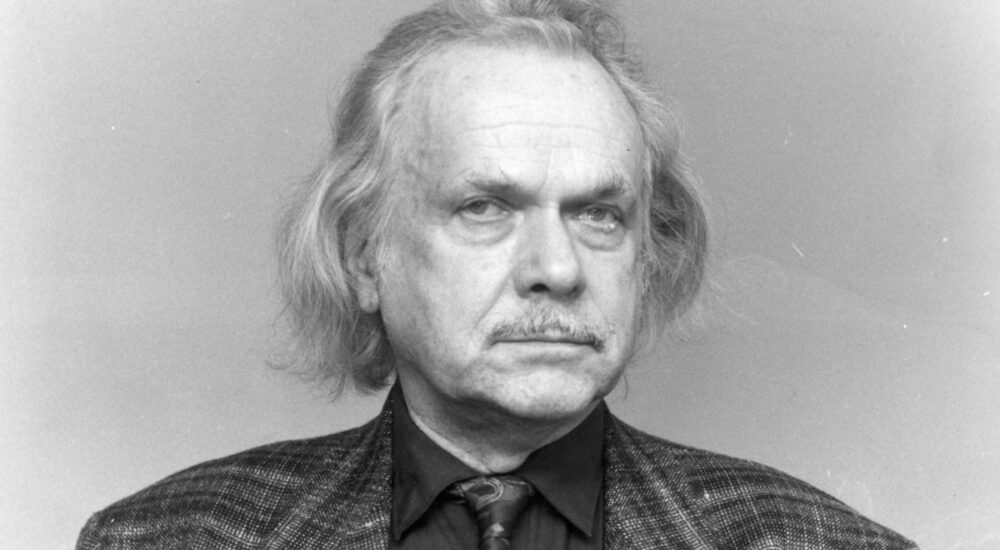
Ilmar Laaban (1921–2000) was an Estonian poet, cultural critic, translator, and publicist. He attended the Tallinn Real School from 1934 to 1940 and began studying piano at the Tallinn Conservatory before graduating. In 1940, he entered the University of Tartu to study Romance languages for a year. The following year, he returned to the Conservatory to study composition under the guidance of Heino Eller. In addition to classical and contemporary music, he was also deeply interested in jazz.
In 1943, Laaban fled to Sweden, where he continued his studies in Romance languages at Stockholm University. His first poetry collection, Ankruketi lõpp on laulu algus (The End of the Anchor Chain is the Beginning of the Song), was published in Stockholm in 1946 and is considered the first intentionally surrealist poetry collection in Estonian literature. His rapid adaptation to his new homeland is evidenced by the 1947 publication of 19 franska poeter (19 French Poets), an anthology of modern French poetry compiled and translated by Erik Lindegren and Ilmar Laaban.
Laaban also translated German and Estonian poetry into Swedish, as well as Estonian poetry into German and French. His Estonian translations have been published in collections such as Oma luulet ja võõrast (Own Poetry and Others’, 1990) and Magneetiline jõgi (The Magnetic River, 2001), which also feature his original texts. In 1957, he published a collection of wordplay-based aphorisms titled Rroosi Selaviste. Laaban was also a prolific writer of palindromes; while most are in Estonian (compiled in Eludrooge ego-ordule, 2008), he also wrote them in Swedish, German, and French. Additionally, he authored art, music, and literary criticism in Swedish, French, German, and Estonian, and frequently delivered lectures on Swedish Radio. His published works include the collection Om musik (On Music, 1988).